Choosing the right AI content generation platform can make or break your e-commerce SEO strategy. With search engines increasingly favoring comprehensive, research-backed content, and AI assistants like ChatGPT influencing purchase decisions, getting this choice right matters more than ever.
Both ContentBoost and Describely promise to solve the content creation challenge, but they take fundamentally different approaches. ContentBoost specializes exclusively in competitive content for Shopify stores, while Describely positions itself as a broader AI content solution.
In this detailed comparison, we'll examine the features, pricing, strengths, and limitations of each platform to help you make the right choice for your e-commerce business. Whether you're a Shopify store owner looking to compete with established brands or need enterprise-grade content capabilities, this analysis will guide your decision.
Quick Overview
ContentBoost is an AI-powered content generation platform built specifically for Shopify stores. It connects directly to your product catalog to create SEO-optimized comparison articles, buyer guides, and competitive roundups. The platform focuses on helping e-commerce brands compete in search results and AI assistant recommendations through research-backed competitive content.
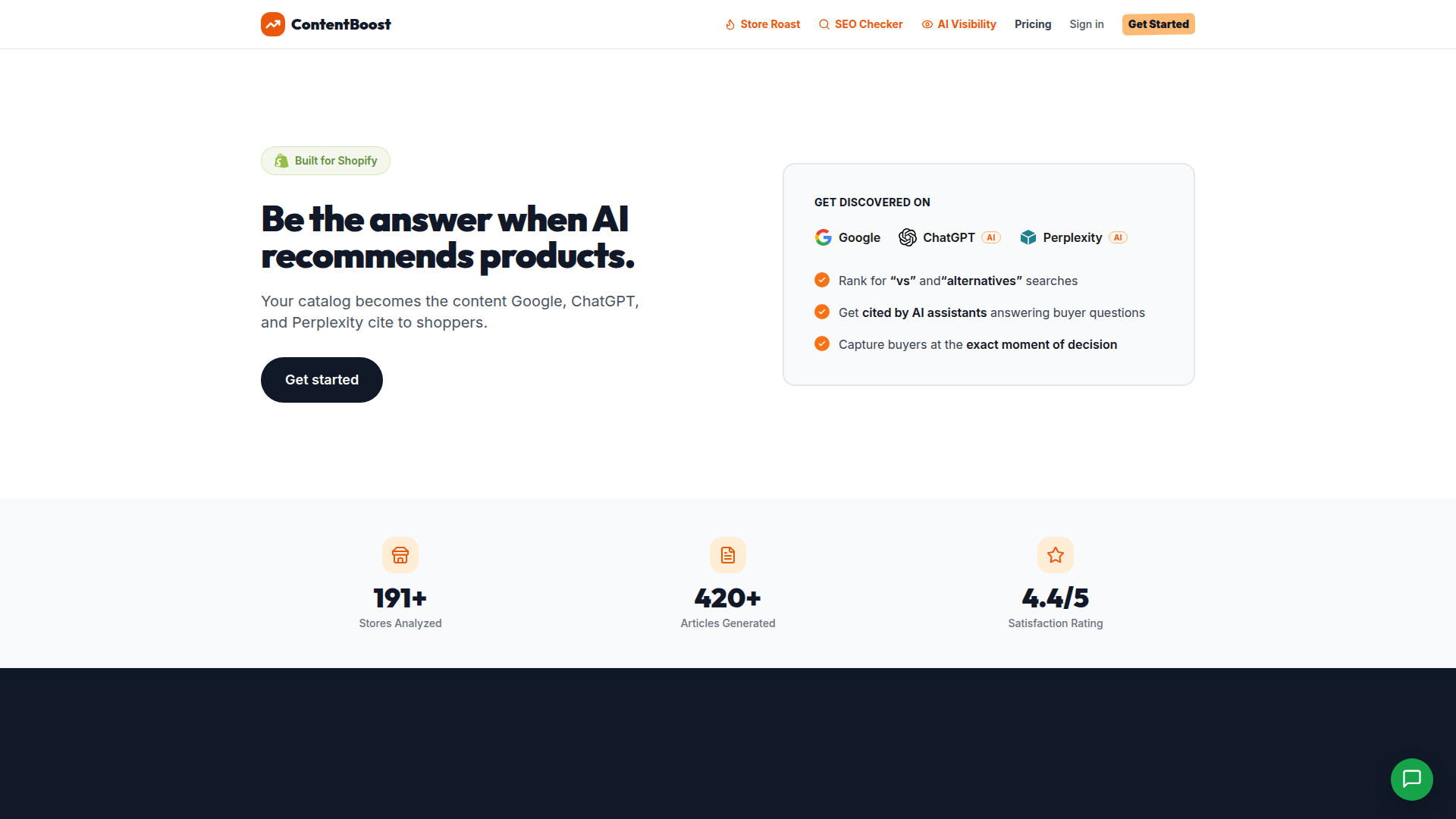
Key ContentBoost features include:
- Direct Shopify store integration
- Automated competitor discovery
- AI visibility analysis and content gap detection
- Specialized content types (VS comparisons, alternatives articles, top/best-of roundups)
- Optimization for AI search engines
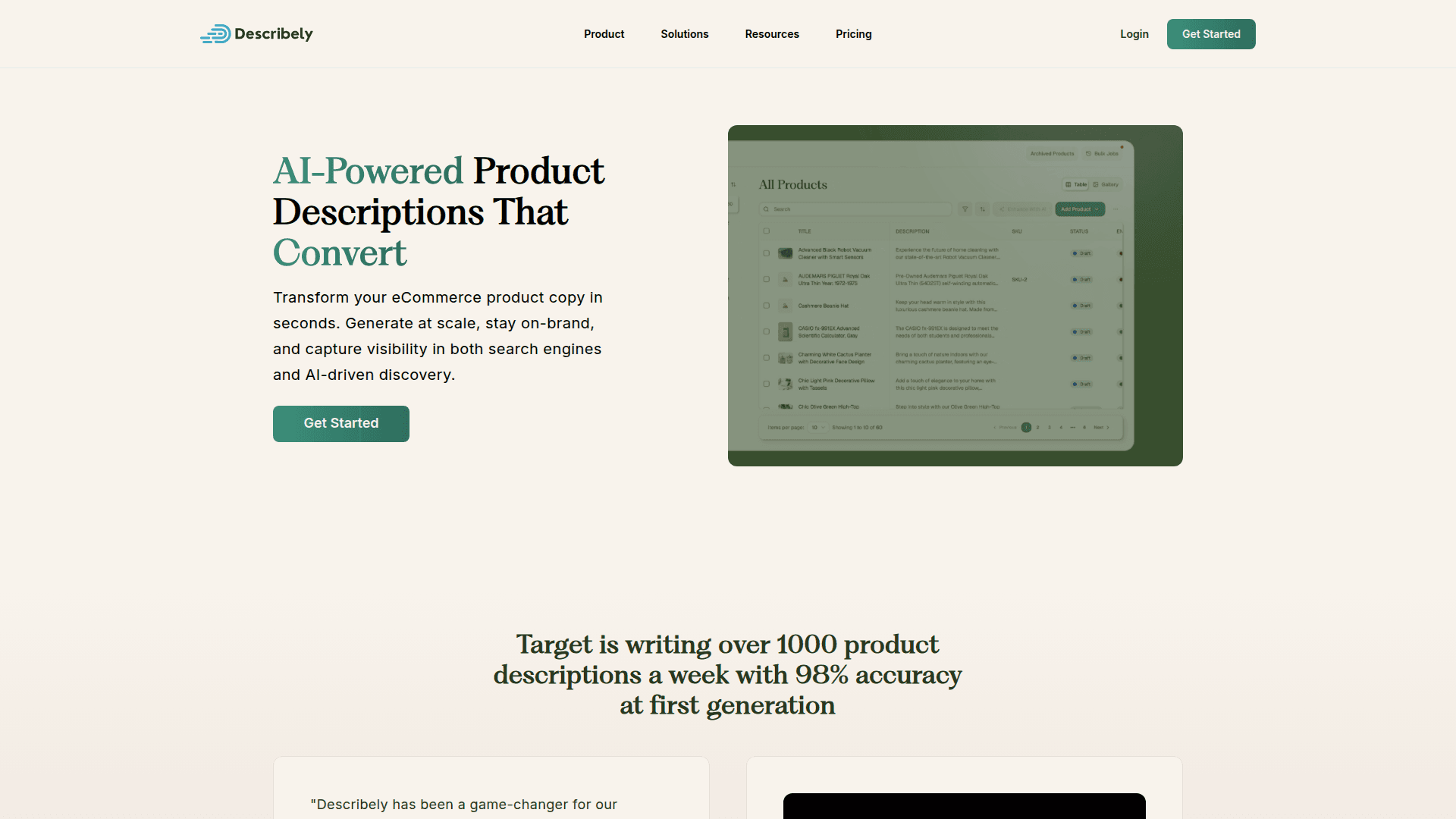
Describely is an AI content platform that offers content generation capabilities for various use cases. Based on available information, it operates on a contact-for-pricing model, suggesting an enterprise or custom solution approach.
The growing importance of AI tools in e-commerce is evident across the industry:
"I'm going to show you step by step how to create an e-commerce website from scratch using AI. And by the end of this video, you'll know exactly how to create a fully functional website that you can use to sell your products online." -- How to Start an Ecommerce Business Using AI
Head-to-Head Comparison Table
| Feature | ContentBoost | Describely |
|---|---|---|
| Platform Focus | Shopify-specific e-commerce | General AI content |
| Content Types | Competitive articles, comparisons, roundups | Various content formats |
| Shopify Integration | Direct catalog connection | Unknown |
| Competitor Analysis | Automated discovery & gap analysis | Unknown |
| AI Search Optimization | ChatGPT, Perplexity optimized | Unknown |
| Pricing Model | Transparent ($79-$299/month) | Contact for pricing |
| Target Audience | Shopify store owners, DTC brands | Enterprise/custom clients |
| Content Volume | 5-40 articles/month | Unknown |
| Setup Complexity | Simple Shopify connection | Unknown |
Where Describely Falls Short
The most significant limitation with Describely is the lack of transparency around its capabilities and pricing structure. For e-commerce businesses that need to make quick, informed decisions about their content strategy, the "contact for pricing" model creates unnecessary friction in the evaluation process.
Limited E-commerce Specialization
Unlike ContentBoost's purpose-built approach for Shopify stores, Describely appears to be a general-purpose AI content platform. This means Shopify store owners miss out on:
- Direct product catalog integration
- Automated competitor identification specific to their niche
- E-commerce-focused content templates and structures
- Understanding of product comparison dynamics
Opaque Feature Set
The challenge with evaluating Describely lies in the limited publicly available information about its specific capabilities. For businesses needing to understand exactly what they're getting, this opacity creates several problems:
- Difficult to assess fit for specific e-commerce use cases
- Unclear content optimization strategies
- Unknown integration capabilities with e-commerce platforms
- Uncertain scalability for growing product catalogs
Generic AI Content Approach
The broader AI content landscape often focuses on quantity over strategic positioning. As research into AI tools reveals:
"AI has promised us easy literature reviews, but not all literature reviews are created equally. I've tested the six best tools and here are the results." -- I Compared Every Popular AI Literature Review Tool So You Don't Have To
This principle applies to e-commerce content generation. Generic AI writing tools often produce content that lacks the competitive intelligence and product-specific optimization that drives actual search visibility and conversions.
Missing Competitive Intelligence
ContentBoost's automated competitor discovery and gap analysis represents a significant advantage that general AI content platforms typically don't offer. Without this intelligence, businesses must manually research competitors, identify content gaps, and develop competitive positioning, tasks that can consume significant time and resources.
Where Describely Wins
Despite the limitations, there are scenarios where Describely's approach may offer advantages over ContentBoost's specialized focus.
Enterprise-Grade Flexibility
The contact-for-pricing model, while less transparent, often indicates more sophisticated enterprise capabilities. Large organizations with complex content needs, multiple brands, or custom workflow requirements may benefit from Describely's potentially more flexible approach.
Platform Agnostic Approach
Businesses not using Shopify or those with multi-platform e-commerce operations might find Describely's broader platform compatibility more suitable than ContentBoost's Shopify-specific design.
Custom Content Types
Organizations requiring content formats beyond competitive articles, comparisons, and roundups may need the flexibility that a general AI content platform provides. This could include technical documentation, internal communications, or industry-specific content formats.
Established Enterprise Relationships
Companies already working with enterprise AI content providers may prefer staying within familiar vendor relationships and contract structures rather than adopting specialized tools for specific use cases.
Who Should Choose What
Choose ContentBoost if:
- You operate a Shopify store with 25-100+ products
- Your primary goal is improving search visibility against competitors
- You want to compete with established brands in your niche
- You need transparent pricing and quick implementation
- Your content strategy focuses on buyer guides, comparisons, and competitive positioning
- You want optimization for AI search engines like ChatGPT and Perplexity
- You prefer automated competitor analysis over manual research
Choose Describely if:
- You operate on platforms other than Shopify
- You have enterprise-grade content requirements across multiple departments
- You need custom content formats beyond e-commerce competitive content
- Your organization prefers vendor relationships with custom pricing and support
- You have complex integration requirements with existing enterprise systems
- Budget transparency is less important than feature customization
Consider alternatives if:
- You're looking for basic blog content rather than competitive positioning
- Your product catalog is under 25 products
- You prefer completely manual content creation processes
- You don't compete directly with other brands in search results
Verdict
For Shopify store owners and DTC brands focused on competitive positioning and search visibility, ContentBoost emerges as the clear choice. Its specialized approach delivers exactly what e-commerce businesses need: research-backed competitive content that helps smaller brands compete with established players.
The key differentiators that tip the scales toward ContentBoost include:
- Purpose-built specialization: Direct Shopify integration and e-commerce-focused features
- Transparent value proposition: Clear pricing and feature sets enable quick decision-making
- Competitive intelligence automation: Saves significant time on competitor research and gap analysis
- AI search optimization: Forward-thinking approach to emerging search behaviors
Describely may serve enterprise clients with complex, custom requirements better, but for the majority of e-commerce businesses seeking to improve their competitive position in search results, ContentBoost's focused approach delivers more relevant value.
The choice ultimately comes down to specialization versus generalization. In the competitive e-commerce landscape, where specific positioning and competitive intelligence drive results, ContentBoost's targeted approach provides the strategic advantage that generic AI content platforms cannot match.
For Shopify store owners ready to compete more effectively in search results and AI recommendations, ContentBoost offers the specialized tools and transparent value proposition needed to make an immediate impact on their content strategy.
ContentBoost Team
The ContentBoost team helps Shopify merchants create product-first content that ranks in search and gets cited by AI engines.